
Choose the Best Terrace Waterproofing Services in Indore
Vishwas Homes provides expert terrace waterproofing services in Indore, specialising in crack repair, polyurethane (PU) membrane liquid systems, and cementitious coatings. Serving Saket, Pipliyahana, Vijay Nagar, and all Indore with supervised execution and a written 2–5 year warranty. Contact 070672 58993 for a free site assessment.
Complete Terrace Waterproofing Solutions
Application Process
Site Inspection and Moisture Diagnostic
We visit your property to conduct a detailed roof assessment using digital moisture meters and visual mapping tools. We mark all visible structural cracks with chalk, map out water ponding zones, and inspect critical leak vectors like parapet wall joints and pipe penetrations. We measure the gradient of the slope across multiple coordinates and provide a photographic report of all findings before detailing any repair specification.
Surface Preparation: Strip, Clean, and Scrape
Long-term membrane adhesion depends entirely on surface cleanliness. We mechanically strip away failing membranes, peeling coatings, algae, and loose coba layers using electric grinders, wire brushes, and chisels. The surface is then washed with a high-pressure jet stream to expose the raw concrete base. We allow the slab to dry completely (until moisture readings drop below the specified limits) before applying any coating.
Slope Repair and Ponding Area Correction
Waterproofing a flat surface with reverse slopes guarantees failure, as stagnant water will eventually track through micro-pores. Where ponding is diagnosed, we repair and re-grade the slab to a minimum 1:100 slope using a high-strength, polymer-modified cement screed. We inspect, clear, and enlarge the rainwater drain outlets to ensure immediate run-off of heavy monsoon downpours.
Crack Sealing and Joint Treatment
We route active cracks into a V-groove pattern using angle grinders, vacuum out the debris, and inject a heavy-duty, highly flexible polyurethane sealant. Crucially, all parapet wall-to-slab junctions, structural expansion joints, and pipe penetrations are reinforced with bond-breaker tape and polyurethane sealant beads. This isolates the waterproofing membrane from joint movements.
Primer Coat Application
We apply a deep-penetrating primer over the dry, prepared concrete slab. The primer penetrates the microscopic pores of the concrete to form a chemical link between the substrate and the liquid membrane. On porous, aged concrete common in older Indore bungalows, we apply a double coat of primer to seal the substrate completely, preventing pinholes and subsequent blistering in the topcoat.
Two-Coat Elastic PU Membrane Application
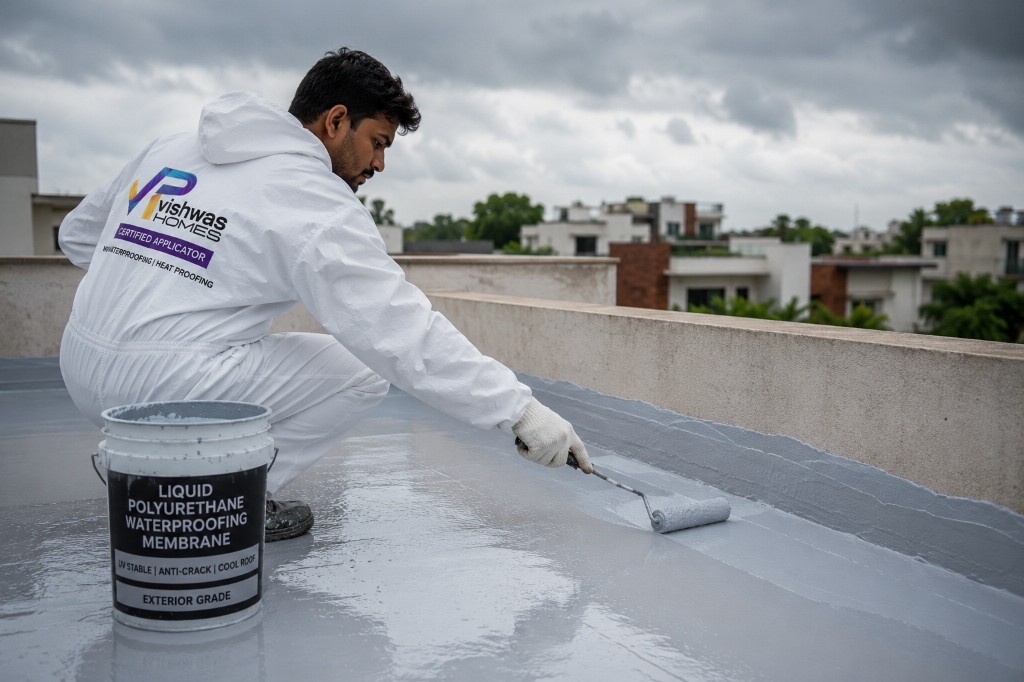
The liquid polyurethane membrane is mixed in exact ratios per climatic requirements and applied in two distinct, cross-directional coats using a roller, brush, or airless spray. We allow the first coat to cure to a tack-free state before applying the second coat at a 90-degree angle to ensure uniform dry film thickness (DFT). We verify the thickness with a DFT gauge to guarantee the membrane complies with performance specifications.
The Costly Cycle of Temporary Terrace Fixes
It is a scene repeated across Indore every July. A homeowner in Saket or Pipliyahana wakes up after a heavy downpour to find a brown water stain creeping across their bedroom ceiling. Within hours, the paint begins to blister, and damp patches spread down the walls. Downstairs neighbours call with concerns - the slab leak is tracking down through the masonry structure.
In a rush to stop the damage, the homeowner calls the same painter who worked on the house a couple of years ago. The contractor looks at the roof, shrugs, and says: "Ek aur coat maar denge, hota rehta hai monsoon mein." (We'll add one more coat, this happens every monsoon). Eager for a quick fix, the homeowner agrees. But six months later, when the next rain hit, the dampness returns, worse than before.
Here is the hard truth: recurring terrace leaks are rarely caused by a simple lack of paint. They are caused by unresolved structural problems beneath the surface - thermal cracking, failed slope design, or breakdown of joints. Applying another layer of generic paint over a cracked, dust-covered surface is not waterproofing; it is simply delaying the inevitable. Effective, long-term terrace waterproofing requires a diagnostic site moisture assessment, not just a paint brush.
"At Vishwas Homes, we do not start with a product recommendation. We start with a moisture meter and a slope inspection. The fix we propose is based on what we actually find - not on what we have in stock."
If you suspect your roof is vulnerable to rain damage, identifying issues early can save thousands in structural repair bills. Book a free site inspection with our supervisors today to trace moisture paths before the dampness damages your interiors.
Why Concrete Terraces Leak: The Two Root Causes
1. Thermal Expansion & Hairline Cracking
Indore experiences extreme temperature swings. During dry summers, concrete slab temperatures can soar to 65–70°C. When a sudden monsoon rain shower hits, the temperature drops to 25°C in minutes. This rapid thermal shock causes repeated expansion and contraction.
Over 5 to 10 years, these micro-movements form hairline cracks. While not structurally dangerous immediately, they destroy the roof's water resistance. A rigid coating cannot bridge these active cracks; it splits and fails within a single monsoon.
2. Slope Failure & Ponding Water
For terraces to drain properly, a minimum slope gradient of 1:100 (1 cm drop per 100 cm of run) is required. In many older bungalows across Palasia, Saket, and Pipliyahana, original slopes have settled or been buried under coba layers.
This loss of gradient leads to ponding - standing water that remains on the roof. It exerts continuous hydrostatic pressure, forcing moisture through microscopic pores. Over time, ponding water creates moss and acidic erosion, rusting internal steel rebars.
Tar Felt vs. Liquid-Applied Polyurethane (PU) Membranes
For decades, the standard waterproofing method for Indore's bungalows built before 2005 was brick bat coba combined with bitumen-based tar felt sheets. The coba provided insulation and gradient, while the tar felt acted as the barrier.
However, this traditional system fails under modern Indore climate conditions. Bitumen becomes brittle under intense UV exposure, and the overlapping seams of tar felt split over years of thermal expansion, allowing water to become trapped in the coba layer.
Modern waterproofing relies on liquid polyurethane (PU) membranes. Applied directly onto the prepared concrete slab as a fluid coating, it cures into a seamless, rubber-like elastic sheet.
Key performance advantages:
- Excellent Crack Bridging The cured elastomer can stretch up to 400%, allowing it to bridge cracks up to 2mm wide as the concrete moves.
- Fully Seamless & UV Resistant No joints, seams, or adhesives to break down. High-grade PU resists solar degradation and lowers roof temperatures.
Note: Liquid PU membranes require precise surface preparation and correct mixing ratios. A poorly applied PU membrane peels and blisters within one monsoon. This is why applicator certification and supervised execution matter more than product selection.
Comparing Roof Waterproofing Systems
Verdict: Never specify brick bat coba or tar felt for an open, exposed terrace being waterproofed today. The system was designed for a different era and a different climate exposure. For Indore's combination of UV intensity and monsoon volume, the only specification that delivers lasting performance is a liquid-applied elastic PU membrane on a properly prepared, slope-corrected concrete slab. Vishwas Homes applies Asian Paints SmartCare and equivalent PU membrane systems with a written warranty in Indore.
Which Coating System Is Right for Your Terrace?
Cementitious Waterproofing
A mineral-based coating mixed with acrylic polymer additives. Best suited for surfaces with minimal thermal movement, such as parapet walls or internal bathroom slabs beneath floor tiles.
- Pros: Highly cost-effective, excellent concrete bonding.
- Cons: Rigid structure; cannot bridge active cracks. Not recommended for exposed roof slabs.
- Cost: ₹45–₹60 per sq. ft.
Elastic Acrylic Waterproofing
A flexible polymer coating (like Asian Paints SmartCare Damp Proof) that offers moderate elasticity. Designed for roofs with light foot traffic and standard structural movement.
- Pros: Good UV resistance, bridges minor hairline cracks.
- Cons: Lower elongation than PU membranes; vulnerable to standing water.
- Cost: ₹55–₹75 per sq. ft.
Liquid-Applied PU Membrane
A high-performance elastomer membrane (like Asian Paints SmartCare PU or Dr. Fixit Torchshield). Recommended for terraces with active leaks, deep cracking, or in multi-story residential blocks.
- Pros: Up to 400% elasticity, bridges cracks up to 2mm, seamless seal.
- Cons: Higher initial cost, requires strict surface preparation.
- Cost: ₹70–₹95 per sq. ft.
If you are unsure which system your terrace requires, that is exactly what our free site inspection resolves. We read the surface, check the existing coating bond, measure moisture, and recommend the minimum system that will provide lasting performance - not the most expensive one.
Cost of Terrace Waterproofing in Indore
The Cost of Inaction
A local contractor offering terrace waterproofing at ₹35 per sq. ft. is almost certainly applying a single coat of cementitious slurry on an unprepared surface without slope correction. For a 1,000 sq. ft. terrace, that saves ₹35,000 today. When the same terrace leaks next monsoon and the ceiling plaster of the room below falls - plaster repair, paint, labour, and disruption - the actual cost exceeds ₹60,000–₹80,000. The math on professional waterproofing always favours the upfront investment.
Apartment & Housing Society Projects
For housing societies and apartment blocks, shared terrace leaks can cause friction between top-floor owners and the society management. We provide unified block inspections and consolidated society pricing, which reduces the per-flat cost significantly. Contact our team to schedule a presentation for your committee.
WhatsApp Society QueryWhy Vishwas Homes for Terrace Waterproofing in Indore
45 Years in Indore (Since 1980)
We have waterproofed concrete roofs that have successfully weathered over 30 monsoon cycles. We understand how local concrete behaves across Indore's distinct seasonal cycles.
Authorized SmartCare Dealer
All waterproofing products are supplied directly from our Pipliyahana retail shop. You receive a GST-itemised material manifest showing exactly which product batch was applied.
Written 2–5 Year Warranty
We cover both materials and labour. If a treated roof leaks within the warranty period, we return and re-treat it. Our warranty is backed by our long-standing business footprint in Indore.
Pre-Application Diagnostics
We never start work without a clear diagnostic assessment. Every project begins with a physical roof inspection, moisture level readings, and a detailed project plan.
Mess-Free Execution Promise
We protect your surrounding structures, mask drainage pipes, and cover tanks before work begins. All construction debris and dust are cleared off the site daily.
Supervised On-Site Management
Our site supervisors manage the mixing ratios, check dry film thickness (DFT) at each stage, and provide a comprehensive completion report with step-by-step photos.
Keeping Your Waterproofed Terrace Leak-Free
A professional waterproofing membrane is designed to withstand severe weather, but regular maintenance will ensure it meets or exceeds its expected lifespan. Treat your roof with these five guidelines:
- Inspect Drain Outlets Regularly: Blocked drain outlets cause rainwater to pool, subjecting the membrane to prolonged hydrostatic pressure. Inspect and clean your drains every three months, especially before and during the monsoon season.
- Check the Surface Post-Monsoon: After the heavy rains subside, walk the roof and check for any physical damage, bubbling, or peeling. Contact us immediately if you spot a suspect area - minor localized repairs are quick and cost a fraction of a full restoration.
- Avoid Drilling Into the Slab: Do not drill, chisel, or install anchors for satellite dishes, solar panels, or clotheslines directly into the treated surface without applying polyurethane sealant around the penetrations. Any unsealed penetration breaks the membrane shield.
- Prevent Physical Puncture Damage: Avoid using the terrace as a storage zone for heavy metal items, broken furniture, or building materials. Sharp edges or high point loads can puncture the protective elastomer film.
- Schedule a Pre-Warranty Audit: Before your workmanship warranty expires, contact us for a final check. If needed, applying a simple maintenance topcoat can extend the lifespan of the underlying membrane by another 4 to 5 years, avoiding the need for a full re-application later.
Book a Free Terrace Waterproofing Inspection in Indore
Our site supervisor will visit your property with digital moisture meters, locate structural cracks, map ponding areas, and check the structural health of your slab. You will receive a written diagnostic report showing exactly what is failing and why - before committing to any repair work.
Every monsoon that passes over an untreated terrace crack adds to your restoration bill. One season of active leakage can rust structural reinforcement bars - a problem that costs ten times more to fix than the waterproofing you deferred.
Cooperative housing society? We provide consolidated quotes for multi-flat terrace projects. Mention 'Society Project' on WhatsApp.
Service Areas: Saket, Pipliyahana, Palasia, Greater Brajeshwari, Vijay Nagar, Bhawar Kuan, Rau, Ring Road, and all Indore.