
Stop Bathroom
Floor Leakage
Without Breaking
Tiles in Indore
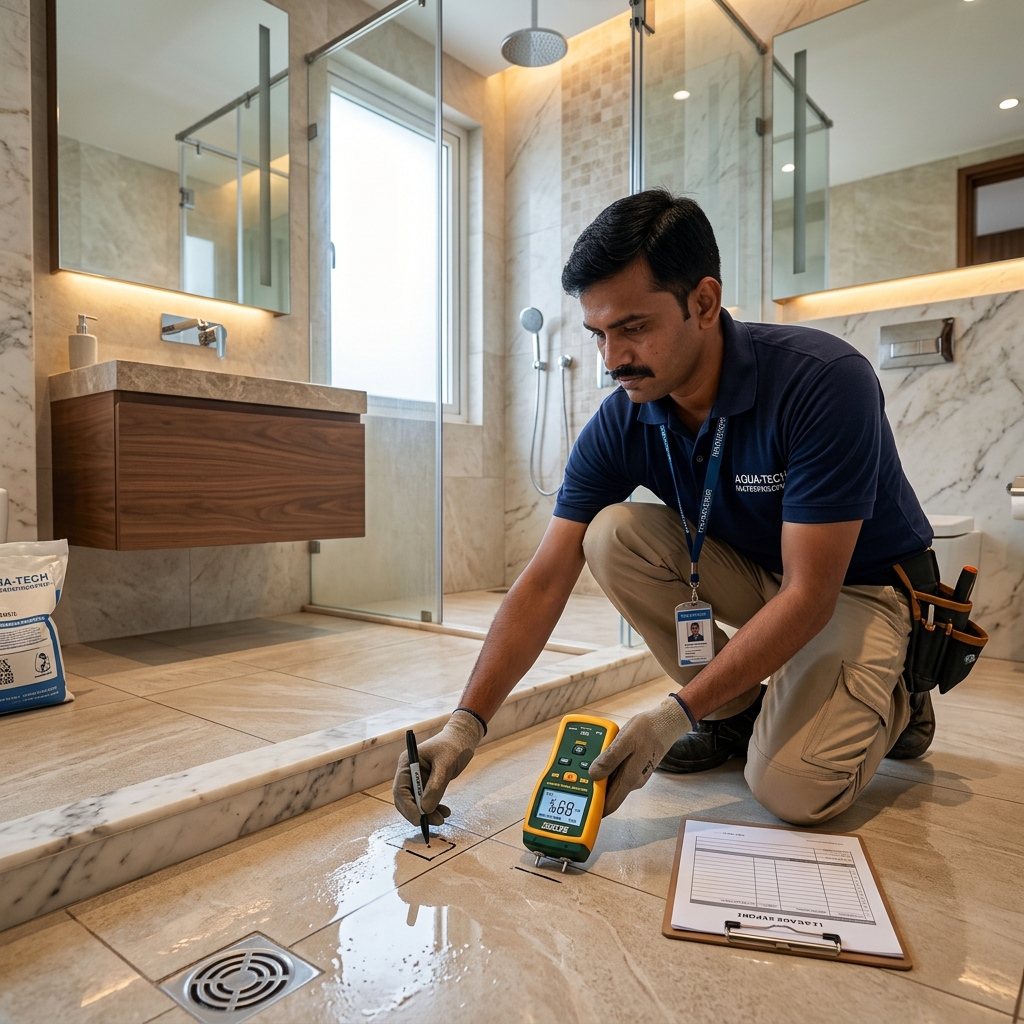
Bathroom waterproofing services by Vishwas Homes in Indore offer long-lasting leakage control, addressing tile grout failures, pipe joints, and wet walls. Serving Vijay Nagar, Saket, Rau, and Annapurna with certified applicators and a written warranty. Call 070672 58993 for a free moisture check.
Complete Bathroom Waterproofing Solutions
Application Process
Moisture Diagnostic Inspection
Before any work is quoted or scheduled, our supervisor visits the site with a digital moisture meter. We scan the bathroom floor (tile surface and grout lines), all four walls up to 3 feet height, the wall–floor junction, and - critically - the ceiling of the room directly below the bathroom. We map all moisture readings on a site sketch and photograph the findings. This is the step that determines whether you need a ₹12,000 grout fix or a ₹65,000 tile removal and re-waterproofing. Skipping it means quoting blind and risking the wrong treatment. We do not skip it.
Joint Stripping and Surface Cleaning
All existing tile grout joints are raked out to a minimum depth of 5mm using a grout saw or oscillating multi-tool. Old sealant at the wall–floor junction and around drain traps is cut out completely. The entire joint network is vacuumed and cleaned to remove loose debris, biofilm, and mould residue. On full tile-removal projects, the adhesive bed is chipped off down to bare concrete. Epoxy grout or PU sealant applied into a dirty or damp joint will not bond permanently. The mechanical cleaning step is what gives the new grout its adhesion. It cannot be skipped to save time.
Flexible Sealant at All Critical Junctions
Before any grout or membrane is applied, all pipe collar joints, drain trap surrounds, and the wall–floor perimeter junction are filled with a flexible polyurethane sealant (not cement mortar). These are movement joints - they expand and contract with temperature changes. Rigid sealants crack at these points; flexible PU sealants accommodate movement without losing their seal. The wall–floor junction and pipe collars are the two most common re-leakage points after bathroom waterproofing. Contractors who use white cement at these junctions are creating a joint that will crack within one to two seasons. Flexible sealant costs marginally more and lasts five to seven times longer at these critical points.
Epoxy Tile Grout Application (Surface Repair Method)
On bathrooms receiving surface treatment only, all raked joints are filled with two-component epoxy grout using a rubber float. Epoxy grout is fully waterproof, chemical-resistant, and does not shrink or crack over time the way cement grout does. It is applied in two passes - a fill coat and a finish coat - with the surface wiped clean before the grout achieves full cure. Standard white cement grout used by most tilers is not waterproof. Epoxy grout costs more per kilogram but eliminates the need for regrouting for 10–15 years. The material cost difference on a standard bathroom is typically ₹2,000–₹4,000 - a fraction of the cost of re-treating a leaking bathroom in two years.
Under-Tile Elastic Waterproofing Membrane (Full Removal Method)
On projects where tiles are removed, a two-component elastic PU or acrylic waterproofing membrane is applied to the bare concrete slab in two coats. The membrane is applied across the full floor area and turned up all four walls to a height of at least 300mm (the splash zone). Pipe penetrations are treated with reinforcing fabric embedded in the wet first coat before the second coat is applied over the top. Total dry film thickness is measured with a DFT gauge. The height of the membrane turn-up on walls is critical. A membrane that ends at floor level does not protect against water that splashes up the wall and tracks behind the tiles. 300mm minimum is non-negotiable on shower areas; in wet rooms without a shower tray we recommend 600mm.
Wall Treatment: Rising Damp and Back-Wall Sealing
Regardless of whether tiles are removed or not, all bathroom walls - particularly the wall shared with the adjacent bedroom - are treated up to 900mm height with a cementitious or acrylic waterproofing coat applied by brush in two coats. This prevents rising moisture from migrating through the wall plaster into the adjacent room. This is the step that protects the bedroom paint and the wardrobe backing board - the two things the homeowner is most visibly worried about. It is also the most commonly skipped step by contractors who quote only for floor treatment. We include it as standard.
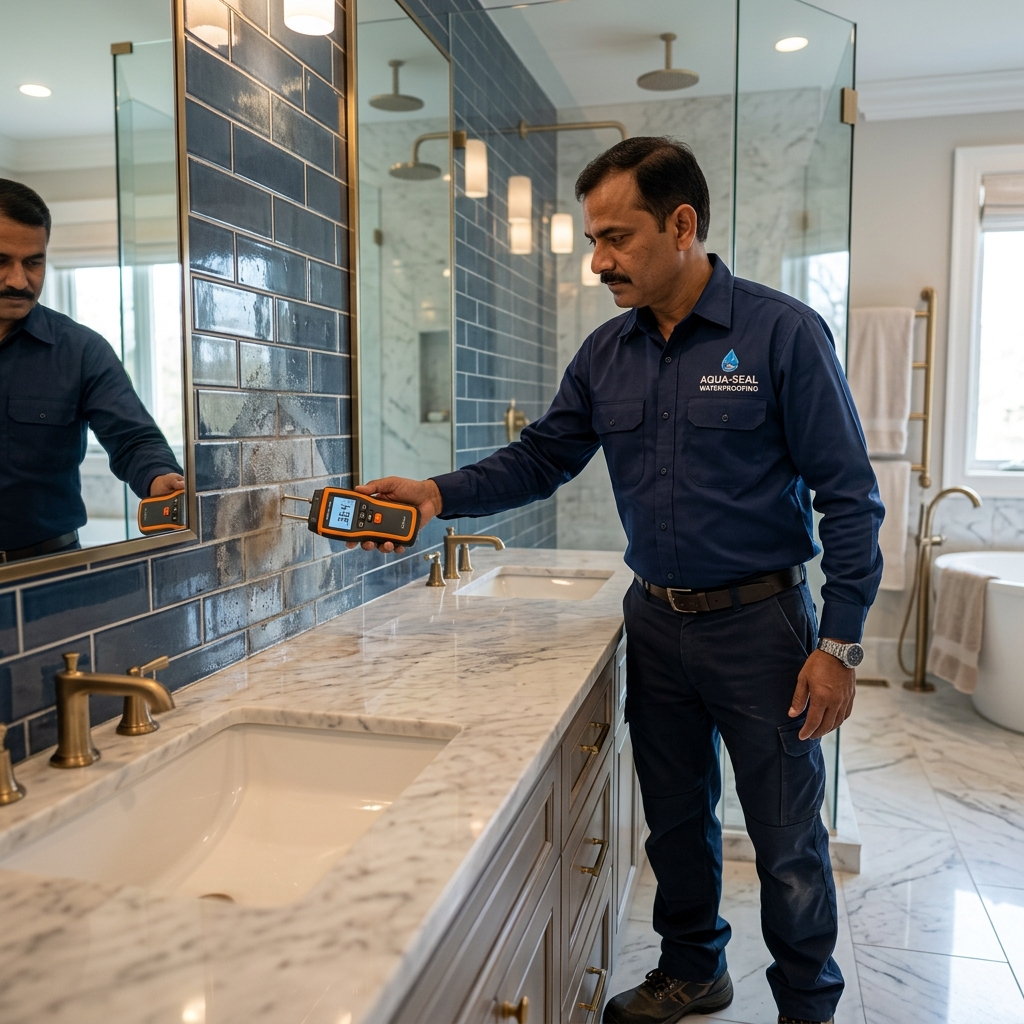
"At Vishwas Homes, we begin with a moisture meter inspection of the floor, walls, and ceiling of the bathroom - and the ceiling of the room below. We map where water is actually moving before we recommend any repair method. The answer to 'do the tiles need to come out?' is not a product decision - it is a diagnostic finding."
The Frustration of Recurring Bathroom Leaks
It is a stressful, escalating problem. You are a flat owner in Vijay Nagar, and you've recently noticed the expensive emulsion paint on your master bedroom wall - the wall shared with your attached bathroom - has started bubbling. On closer inspection, the plaster feels soft and slightly wet. The custom wardrobe pushed against that wall has developed a musty smell, and its backing board is beginning to warp at the bottom. To make matters worse, your downstairs neighbours have just texted you a photograph of a brown water stain spreading across their ceiling directly below your bathroom.
In a rush, you call a local plumber. The plumber arrives, seals the drain trap with white cement, and assures you the problem is solved. Three weeks later, the damp patch on your bedroom wall returns. Frustrated, you call a painter who applies a quick coat of waterproofing paint directly onto the bathroom tiles. Two monsoons later, that paint blisters and peels away. The root cause was never actually identified. The fixes were entirely cosmetic, while the water damage continued quietly destroying the masonry inside your walls.
Bathroom leakage is almost never a single-source problem. In most Indore flats built between 2005 and 2020, the root cause is a hidden combination of deteriorated tile grout, a missing or failed waterproofing membrane beneath the floor tiles, and pipe collar joints that have loosened over years of thermal cycling. Fixing only one element - the grout, or the drain, or the wall - without diagnosing all three means the problem is guaranteed to return.
Stop wasting money on blind fixes. Book a free moisture check with our supervisors today to pinpoint the exact source of your bathroom leakage.
Why Bathrooms Leak: The Three Root Causes
1. Tile Grout Deterioration
Standard cement-based tile grout is not waterproof - it is water-resistant at best. Over 4–8 years of daily exposure to hot water, cleaning chemicals, and thermal expansion, the grout begins to develop hairline cracks, shrinks away from tile edges, and becomes porous. Once the grout seal breaks, water enters the gap between tiles, travels through the adhesive bed, reaches the concrete slab below, and begins seeping. This is the most common root cause in Vijay Nagar apartments - buildings that are now 6–12 years old where the original grout is reaching end of life.
How to spot it: Grout lines look discoloured, slightly sunken, or crumble when scratched with a key. There may be efflorescence (white salt deposits) on the surface.
2. Missing or Failed Under-Tile Membrane
Many Indore apartments built before 2015 were constructed without a proper waterproofing membrane beneath the bathroom floor tiles. Builders applied a thin coat of cement waterproofing slurry (or nothing at all) before tiling. This slurry degrades within 5–7 years. Once it fails, the bathroom floor effectively has no barrier between the tile adhesive layer and the structural concrete slab below. Even perfect tile grout cannot prevent leakage in this scenario. Water eventually finds a micro-gap and enters the slab directly.
3. Pipe Collar and Drain Trap Failure
Every pipe that passes through the bathroom floor - the drain outlet, waste pipe, and water supply pipes - creates a penetration point in the slab. At construction, these joints are sealed with plumber's putty or basic cement mortar. Over years of vibration from water flow and thermal movement of the pipes, these seals crack. The result is a direct water pathway from the bathroom into the slab, regardless of how good the tile grout or membrane is in other areas. This is why plumber-only fixes frequently fail - they address the visible connection, but not the buried collar joint.
Can You Waterproof a Bathroom Without Breaking Tiles?
This is the question every homeowner in Indore asks, and we will answer it with precise honesty. Sometimes tiles must come out, and sometimes they do not. The correct answer is always determined by a proper site inspection.
When tile-free repair is possible - Chemical Injection Grouting
If the root cause is limited to grout deterioration - and the under-tile membrane is confirmed intact (or the building is recent enough that the original membrane was adequate) - it is absolutely possible to waterproof your bathroom without removing tiles.
The Method: Existing grout lines are raked out to a minimum depth of 5mm using an oscillating tool, cleaned thoroughly, and re-filled with waterproof epoxy grout (for complete joint replacement) or injected with a low-viscosity polyurethane grout sealer (for hairline cracks). Drain and pipe collar joints are re-sealed with flexible polyurethane sealant. The wall–floor junction - the most vulnerable joint in any bathroom - is treated with a flexible sealant bead followed by an acrylic waterproofing coat up to 3 feet in height.
This method costs significantly less than tile removal and produces lasting results - but only when the root cause is grout and joint failure, not membrane failure.
When tile removal is unavoidable
If the moisture meter confirms water present at the slab level beneath the tiles - detectable by scanning the ceiling of the room below and finding active damp spots directly under tile joints - then the membrane has completely failed. Grout injection on the surface does not reach the slab.
The only permanent solution in this scenario is to remove the tiles, clear the adhesive bed, apply a new elastic PU waterproofing membrane on the bare slab, allow it to cure, and then re-tile. We will never tell you that you don't need tile removal when the moisture data says otherwise. A tile-free fix on a failed membrane is not a cheaper solution - it is a temporary one that will fail again within one or two monsoon seasons, costing you more in the long run.
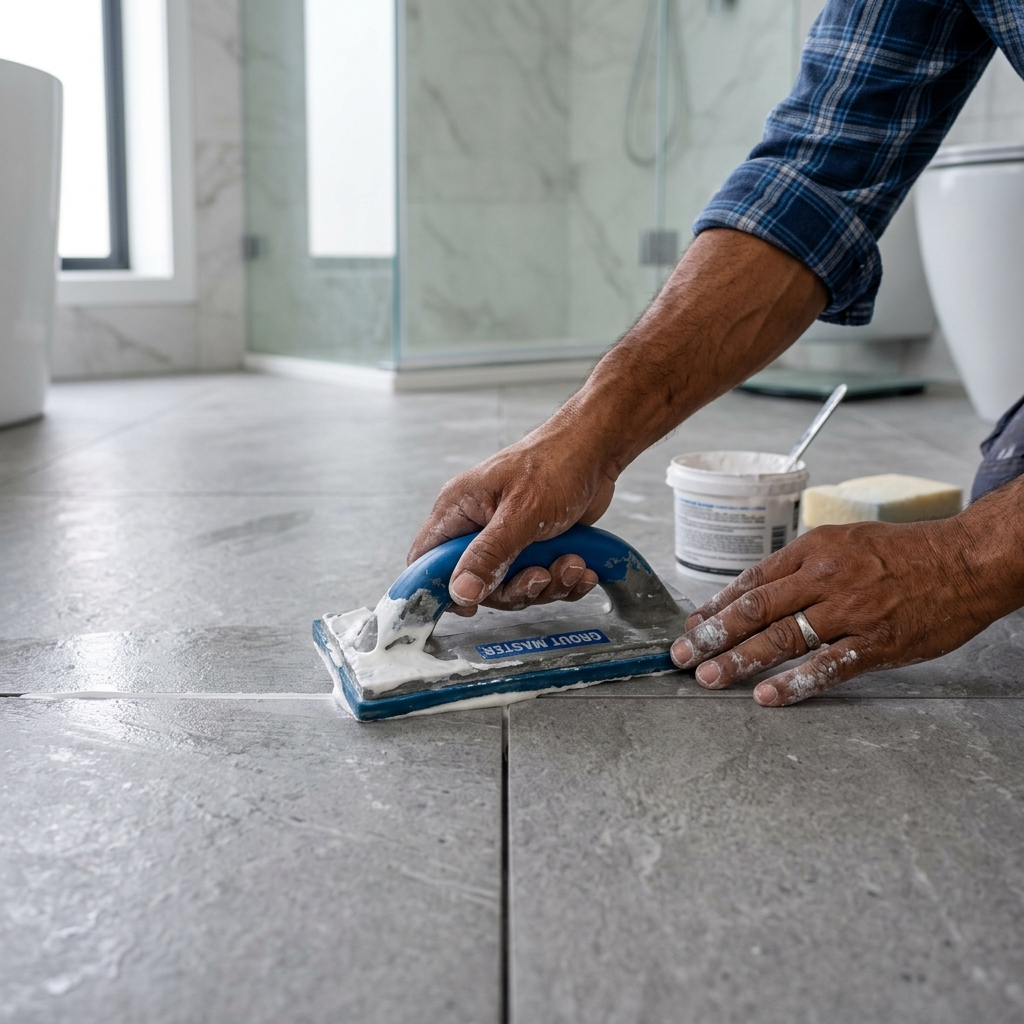
The Diagnostic Decision Point: "Whether tiles come out or stay is not a guess - it is determined by the moisture mapping we conduct at the start of every project. We map three surfaces: the bathroom floor, the bathroom walls, and the ceiling of the room below. The combination of readings tells us exactly how deep the water has penetrated and which repair method is appropriate."
Epoxy Grout Injection vs. Complete Tile Removal
Which Bathroom Waterproofing System Is Right for Your Case?
Minor Grout Cracking (Under 8 Years Old)
Diagnostic: New-ish flat, minor grout cracking, no active ceiling stain below.
Cost: ₹8,000–₹22,000 depending on size.
Warranty: 2–3 years written.
Active Ceiling Dampness (8–15 Years Old)
Diagnostic: Older flat or bungalow, active damp on ceiling below, moisture confirmed at slab level.
Cost: ₹35,000–₹65,000 (excluding re-tiling).
Warranty: 3–5 years written.
Severe Leakage with Wall Damage
Diagnostic: Long-standing leakage with structural plaster damage on the adjacent bedroom wall.
Cost: ₹65,000–₹1,10,000 (full restoration).
Warranty: 3–5 years written.
If you are unsure which scenario applies to your bathroom, that is precisely what our free moisture check resolves. We will not quote you for Scenario B if Scenario A is adequate - and we will not pretend Scenario A will work when the data tells us Scenario B is needed.
Cost of Bathroom Waterproofing in Indore
Note for Flat Owners: In cooperative housing societies where bathroom leakage is a floor-to-floor dispute, we provide documentation of findings and repair scope that can be shared with the society management committee. Contact us for details.
Why Vishwas Homes for Bathroom Waterproofing in Indore
45+ Years in Indore
We have treated bathrooms in buildings of every era - 1980s bungalows in Palasia with no original membrane at all, and 2018 Vijay Nagar apartments. We know the failure patterns by building age and zone.
Diagnostic-First Approach
Every bathroom project begins with a written moisture diagnostic report. You receive a site map, photographs of all moisture readings, and a written scope before any work is agreed. No surprise upselling on site.
Authorised SmartCare Dealer
All waterproofing materials are supplied directly from our Pipliyahana retail shop. You receive a GST-itemised material manifest confirming the exact product applied - not a verbal assurance.
Written 2–5 Year Warranty
Covering both materials and labour. If the treated bathroom leaks within the warranty period, we return and re-treat at zero cost. Our warranty is backed by 45 years of presence in Indore.
Mess-Free Promise
All bedroom furniture, flooring, and hallway surfaces adjacent to the bathroom are masked and protected before demolition or treatment begins. Debris from tile removal is bagged and cleared daily.
Supervised Execution
A Vishwas Homes site supervisor manages mixing ratios, application thickness, curing schedules, and DFT measurements. You do not manage the labour - we do.
Keeping Your Bathroom Leak-Free After Waterproofing
A professional finish is designed to withstand severe wear, but regular maintenance will ensure it meets or exceeds its expected lifespan. Treat your bathroom surfaces with these simple guidelines:
- Gentle Cleaning Protocol: Clean bathroom tile grout annually using a diluted bleach solution and a stiff brush; do not use acidic bathroom cleaners on epoxy grout as they erode the surface gloss over time.
- Bi-Annual Sealant Checks: Inspect the wall–floor junction and drain collar seal every six months - if a hairline crack appears in the flexible sealant, report it immediately; a sealant top-up costs a fraction of re-treatment.
- Strict No-Drill Zone: Do not drill into the bathroom walls below 900mm without informing us - drilling through the waterproofing membrane layer voids the warranty at that penetration point unless the hole is resealed with flexible sealant.
- Post-Plumbing Audits: After any plumbing repair that involves opening the floor or wall, request a moisture scan before closing the surface - we can inspect and re-treat a targeted area far more cheaply than a full re-waterproofing.
- Pre-Warranty Final Check: Before your warranty expires, schedule a free inspection with us - we will assess the grout, sealant joints, and wall treatment and recommend whether a maintenance application is needed.
Book a Free Bathroom Moisture Check in Indore
Our supervisor visits your bathroom with a digital moisture meter and maps the exact source of leakage - floor, wall, drain collar, or all three. You receive a written diagnostic report and itemised quote before committing to any repair. No pressure, no guessing, no surprises on site.
We will tell you honestly whether your tiles need to come out. If they don't, we will fix the problem without removing them. If they do, we will show you the moisture data that explains why.
Flat owner in a dispute with neighbours about bathroom leakage? We provide moisture diagnostic documentation for society management committees. Mention 'Society Dispute' on WhatsApp.
Service Areas: Vijay Nagar, Palasia, Saket, Pipliyahana, Rau, Annapurna, Bhawar Kuan, and all Indore.