
How to Treat Peeling Paint on Damp Walls Permanently in Indore
Vishwas Homes provides professional wall dampness treatment in Indore, diagnosing and permanently treating efflorescence (shora), rising damp, and paint peeling caused by moisture infiltration in walls. Serving Palasia, Saket, Vijay Nagar, Rau, and all Indore with certified applicators and a written 2–5 year warranty. Free site moisture assessment - WhatsApp 070672 58993.
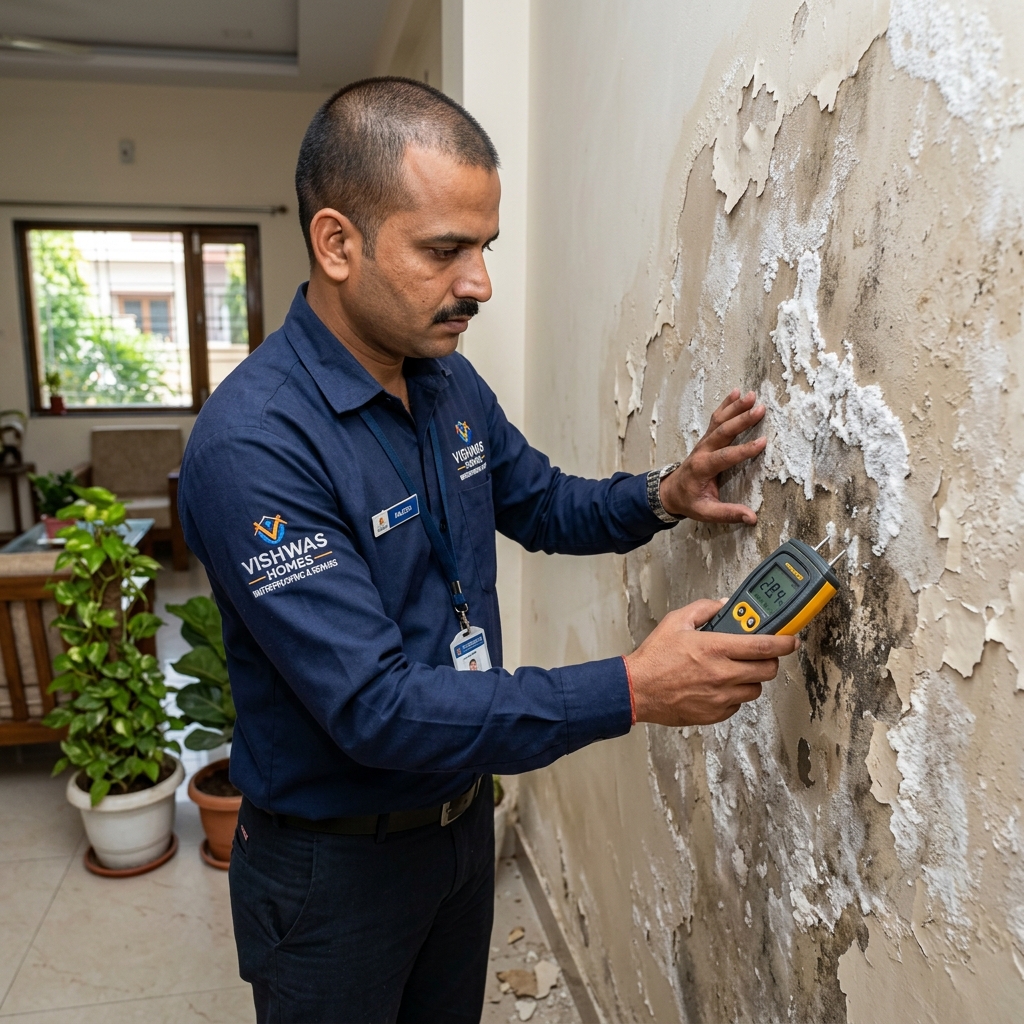 Image Placeholder
 "At Vishwas Homes, we do not start with a product recommendation. We start with a detailed diagnostic inspection. The fix we propose is based on what we actually find."
Painting Over Dampness is Concealment, Not Treatment
Imagine this common scene in a bungalow in Palasia: You notice a grey damp patch spreading across the bedroom wall adjacent to the external boundary wall. You had the room repainted just eight months ago. The putty and emulsion looked fresh and clean at the time. Now, the paint is bubbling along the bottom two feet of the wall, and a white powdery crust - locals call it shora - has appeared at the skirting level. The room smells faintly musty, especially after the rain.
You call the same painter who did the job eight months ago. He says the old paint was cheap or the putty wasn't applied thickly enough. He proposes another coat - this time with "waterproof paint." You agree. Six months later, the exact same patch returns.
Here is the truth: the painter was not lying about the paint - he simply misidentified the problem. Waterproof paint applied on the surface of a wall does not stop moisture that is rising from the foundation or infiltrating through a crack in the external plaster. The moisture source is structural, not superficial. No surface coating can block moisture pressure pushing from the inside of a wall. The fix must address where the water is coming from - not just what it looks like on the paint surface.
At Vishwas Homes, we begin wall dampness treatment with a site moisture diagnostic. We scan the wall with a digital moisture meter at multiple heights, check the external wall condition, and inspect adjacent areas like the terrace parapet and bathroom before recommending any treatment. The right treatment depends entirely on the source of moisture, and that source is different in every single case.
If you suspect structural moisture issues, Book a free site assessment to get a professional diagnostic before the problem worsens.
What Is Wall Dampness (Seelan) and Why Does It Keep Coming Back?
Understanding why your previous painter's solution failed requires distinguishing between four distinct types of dampness.
Type 1 - Rising Damp (Ascending Moisture from Foundation)
Rising damp occurs when groundwater travels upward through the pores of brick or block walls by capillary action - the exact same mechanism by which a dry sponge absorbs water when its bottom edge touches a wet surface. In older bungalows in Palasia, Saket, and parts of Rau built before modern damp-proof course (DPC) specifications were standardised, rising damp is extremely common.
The tell-tale signs: The damp patch appears consistently at the bottom of the wall - typically between 300mm and 1,200mm from the floor level - and does not extend higher regardless of rainfall. Efflorescence (white salt deposits) appears at this zone because as the water rises through the wall and evaporates at the surface, it leaves behind the salts dissolved from the brick and mortar.
Why paint fails here: The moisture is rising from below the paint, not above it. No matter how thick or waterproof the surface coating is, the moisture hydrostatic pressure from behind the wall is far greater than the coating's adhesion to the plaster. The paint blisters, then peels.
Type 2 - Penetrating Damp (Lateral Moisture from Cracked External Plaster)
Penetrating damp enters the wall horizontally - through cracks in the external plaster, gaps in the external window frame sealant, or degraded brick mortar joints (called pointing). In Indore's intense monsoon, even a tiny 1mm crack in the external render can allow significant water ingress during heavy, wind-driven rain.
The tell-tale signs: The damp patch on the interior wall appears during or after heavy rain, is not limited to the bottom zone, and often corresponds directly in position to a crack, window frame, or plinth beam joint on the external wall. It may dry out partially between rain events, then reappear.
Why paint fails here: Sealing the interior surface does not close the external crack. Water continues entering; it simply cannot escape inward as quickly. It accumulates in the wall structure itself, accelerating mortar and brick degradation over time.
Type 3 - Efflorescence (Shora): The Symptom, Not the Disease
Efflorescence - widely known locally as shora - is the white, powdery crystalline deposit that appears on wall surfaces. It is not a type of dampness itself; it is the visual evidence of moisture movement through a wall. When water carries dissolved salts from cement, brick, or mortar through the wall and evaporates at the surface, the salts crystallise and form the characteristic white crust.
Why scraping and repainting fails here: The salt crystals form beneath the paint film, pushing it off the wall from behind. Until the moisture source is stopped, the crystallisation cycle continues endlessly. Scraping shora and applying a fresh coat of paint is never a treatment - it is merely a cosmetic delay.
Type 4 - Condensation Dampness (Internal Moisture Accumulation)
Condensation occurs when warm, humid indoor air contacts a cold wall surface - typically in poorly ventilated bathrooms, kitchens, and north-facing bedrooms in older buildings. In Indore's monsoon, when outdoor humidity is high and indoor air conditioning creates a sharp temperature differential between air and wall surfaces, condensation can be severe.
This type is distinct from the others because the moisture source is airborne, not structural. Treatment is entirely different: improving ventilation and the thermal resistance of the wall, rather than waterproofing the structure.
Correctly identifying which type of dampness is affecting your wall is not guesswork - it requires a moisture diagnostic. A treatment prescribed without a diagnostic is a guess, and the statistics on repeat damp treatment failures in Indore suggest that most homeowners' second paint job was based on exactly that kind of guess.
What Is Efflorescence (Shora) and Why It Ruins Interior Paint?
Efflorescence is the most common and most misunderstood wall dampness symptom in Indore. To permanently treat it, you must understand the underlying chemistry.
Why shora forms in Indore specifically
Indore's alternating monsoon saturation and summer heat accelerates the salt leaching cycle. During the monsoon, water saturates the wall. During summer, rapid evaporation drives the moisture quickly to the surface, carrying salts with it. This seasonal cycling - common in all of Madhya Pradesh's semi-arid climate zone - means shora formation is faster and more aggressive here than in coastal cities with more consistent humidity levels.
Why commercial "anti-shora" paints fail
Most local painters will propose an "alkali-resistant primer" or "anti-efflorescence paint" as the definitive solution. The honest truth is that this approach is highly limited. Alkali-resistant primers reduce the rate at which salts damage the paint film, but they absolutely do not stop the moisture movement that produces the salts. The primer surface eventually saturates, and the same cycle begins again - typically within 18-24 months.
What crystalline waterproofing does differently
Crystalline waterproofing compounds (such as Xypex, Dr. Fixit Krystal, or Asian Paints SmartCare Damp Block) work via a chemical reaction within the concrete or masonry matrix. When applied to a damp wall, the active chemicals react with free lime and water inside the substrate to form insoluble crystals. These permanently fill the capillary pores and micro-cracks in the wall material. Unlike a surface coating, the crystalline barrier is within the wall - it cannot be pushed off by moisture pressure from behind.
When crystalline treatment alone is not sufficient
We are always honest about limitations. Crystalline treatment works brilliantly on sound brick or concrete with hairline pore-level moisture movement. However, it does not work on walls with active structural cracks wider than 0.3mm, walls where the DPC has completely failed (severe rising damp with high ground saturation), or walls where the moisture source is external penetrating damp through unfilled cracks. In these cases, external remediation - such as crack repair, external waterproof render, or DPC injection - must accompany the crystalline internal treatment.
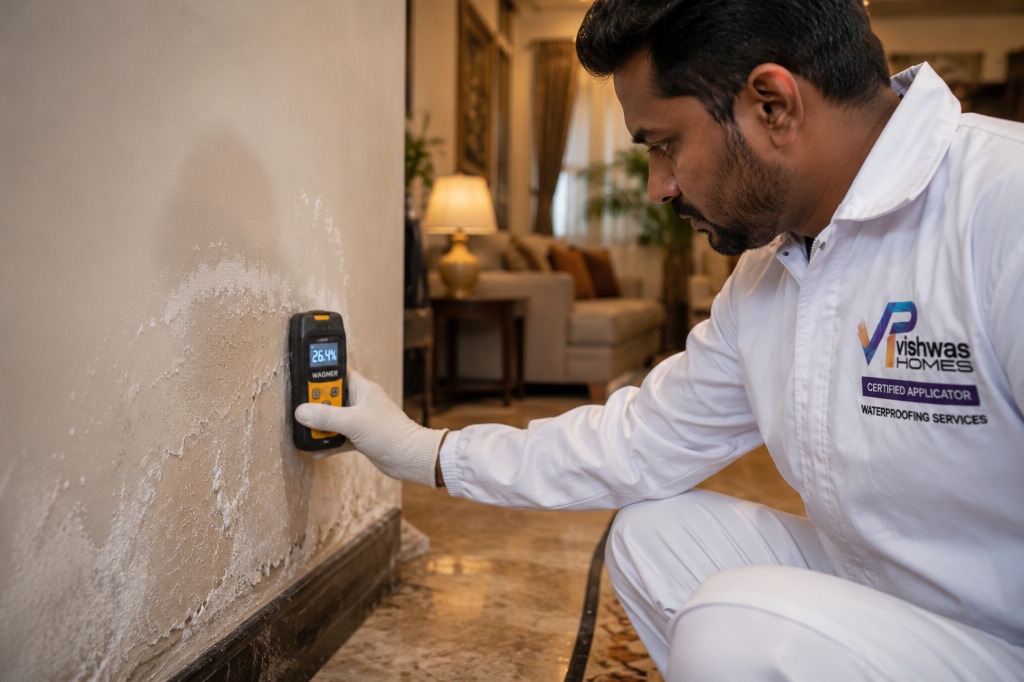
Diagnostic Moisture Scanning
We do not guess. We trace subsurface leaks using digital moisture meters before proposing a waterproofing solution.
Book Free AssessmentRepainting Over Dampness vs. Professional Damp Treatment
A direct comparison between the temporary fix you have likely already tried and the professional diagnostic approach Vishwas Homes offers.
Our Wall Dampness Treatment Process - Step by Step
Every step is evidence of diagnostic discipline and professional craft. We don't just apply chemicals; we engineer a barrier.
Site Moisture Diagnostic (Before Quoting)
Our supervisor visits the site and scans all affected walls with a digital moisture meter, taking readings at multiple heights (floor level, mid-wall, and ceiling junction) and comparing readings on both the interior and the corresponding exterior surface. We also inspect adjacent areas - the floor above (for terrace leakage), the bathroom behind the wall (for pipe joint leakage), and the external plaster condition. All readings and observations are mapped and photographed.
Why it matters: The treatment for rising damp is different from the treatment for penetrating damp from an external crack. Prescribing a treatment without a diagnostic is how homeowners end up repainting the same wall every eighteen months. We do not quote before we scan.
Hack Damp Plaster and Neutralise Efflorescence
All existing plaster in the affected zone that is hollow, soft, or saturated is hacked off down to the bare brick or block substrate. This is non-negotiable: applying new plaster or waterproofing treatment over damp, failing plaster produces the same result as the previous failed paint job. Exposed shora deposits are treated with an efflorescence neutraliser (a diluted acid wash) to chemically dissolve the surface salt crystals and neutralise the alkalinity before any treatment coat is applied.
Why it matters: Salt deposits left on the substrate surface prevent the adhesion of any treatment coat. The acid wash neutralises the alkalinity that corrodes ordinary putty and emulsion. Skipping this step is the single most common reason damp wall treatments fail.
External Crack Repair (Where Applicable)
Where the moisture diagnostic confirmed penetrating damp from an external source, our team repairs all cracks in the external plaster using polymer-modified crack filler and applies a waterproof external render coat on the affected elevation. Window frame joints are re-sealed with flexible polyurethane sealant.
Why it matters: No interior treatment can stop water that is entering through an unsealed external crack. Interior waterproofing without external crack repair is like mopping the floor while the tap is still running. Both must be addressed in the same project.
Crystalline Waterproofing Compound Application
For walls with confirmed moisture movement through the substrate, a crystalline waterproofing compound is applied to the bare brick or concrete in two coats, keeping the surface damp during application to activate the chemical reaction. The crystals form within the substrate pores over 7–14 days, permanently blocking the capillary channels through which moisture was moving.
Why it matters: Unlike a surface membrane that can be pushed off by hydrostatic pressure, crystalline treatment is a permanent change to the wall material itself. It cannot peel, crack, or delaminate. Where conditions are suitable, it is the most durable internal dampness treatment available.
Polymer-Modified Sand Cement Replastering
Once the crystalline treatment has cured (minimum 7 days), the hacked areas are replastered with polymer-modified sand cement plaster - not standard cement plaster and not gypsum. The polymer additive improves the plaster's water resistance and adhesion to the treated substrate. The new plaster is applied in two coats: a scratch coat and a finish coat, with adequate curing time between.
Why it matters: Standard gypsum plaster applied over a damp-prone wall absorbs moisture readily and fails quickly. Polymer-modified plaster provides a damp-resistant base for the final paint system and bonds durably to the crystalline-treated substrate.
Alkali-Resistant Primer Application
An alkali-resistant primer is applied to the replastered and fully cured surface before any wall putty or topcoat. This primer creates a chemical barrier between the alkaline plaster and the paint system, preventing paint saponification (the chemical process that causes paint to become soft and peel on alkaline surfaces).
Why it matters: Fresh plaster and cement-based surfaces are highly alkaline. Standard primers and putties fail on fresh plaster within 1–2 years due to alkali attack on the binder. The alkali-resistant primer is the step that separates a 2-year paint job from a 7-year one.
Wall Putty and Finish Paint Application
High-quality wall putty is applied in two coats over the cured primer, sanded smooth, and a premium interior emulsion (Asian Paints Royale or equivalent) is applied in two finish coats. On walls where sheen or washability is important - rental properties, hotel rooms, PG facilities - a washable satin emulsion is specified.
Why it matters: The finish coat is the only part of this 7-step process that the homeowner sees. The durability of what they see depends entirely on the 6 steps beneath it. Contractors who offer only the finish coat are offering just 10% of the solution.
Which Damp Treatment System Is Right for Your Wall?
A decision guide based on common Indore residential scenarios. We do not offer a fixed "menu" - we prescribe based on diagnostics.
Scenario A
"Shora and bubbling paint in a room adjacent to an external wall, building under 15 years old, no structural cracks visible."
Likely cause: Rising damp or penetrating damp through degraded mortar joints.
Treatment: Hack damp plaster, efflorescence neutralisation, crystalline waterproofing compound on bare substrate, polymer-modified replastering, alkali-resistant primer, final finish. External mortar joint repointing if required.
Cost: ₹55–₹90 per sq. ft. on the affected area.
Warranty: 3–5 years written.
Scenario B
"Damp patch on an internal wall corresponding to a visible crack on the external wall, appearing only during or immediately after heavy rain."
Likely cause: Penetrating damp from external crack.
Treatment: External crack repair with polymer filler and waterproof render on affected elevation, window frame re-sealing, internal surface treatment (priming and finish coat only if plaster is sound).
Cost: ₹40–₹70 per sq. ft. (external elevation) plus ₹30–₹50 per sq. ft. (internal finish).
Warranty: 2–3 years written.
Scenario C
"Bottom-of-wall dampness in an older bungalow (pre-2000), extending up to 1 metre from floor level, severe shora present, no original DPC."
Likely cause: Rising damp from foundation with failed or absent damp-proof course.
Treatment: Full rising damp protocol - hack plaster to affected height plus 300mm above visible line, full crystalline treatment, DPC injection grouting at base (if warranted), polymer-modified replastering, alkali-resistant primer, and finish coat. The most permanent solution.
Cost: ₹90–₹140 per sq. ft. on the affected zone.
Warranty: 3–5 years written.
If you are not sure which scenario applies to your wall - and most homeowners are not - that is exactly what our free site moisture assessment establishes. We will not prescribe Scenario C treatment if Scenario A is what the diagnostic shows.
Cost of Wall Dampness Treatment in Indore
* Pricing ranges are estimates contingent on site inspection findings. A flat price is never given without a moisture diagnostic.
The True Cost of Inaction
A painter applying waterproof emulsion directly over a damp wall charges ₹20–₹35 per sq. ft. For a 100 sq. ft. affected wall, that is ₹2,000–₹3,500 per repaint. In Indore's monsoon-driven cycle, that wall typically needs repainting every 12–18 months. Over 5 years: you have spent ₹7,000–₹17,500, the moisture problem remains completely unresolved, and the plaster is gradually deteriorating into a soft powder.
A single professional treatment at ₹6,000–₹9,000 for the same wall, backed with a 5-year warranty, costs less than two repaint cycles - and actually solves the structural problem.
For Landlords, PG & Hostel Operators (Rau, Bhawar Kuan, Annapurna):
If you are repainting rental rooms every 2 years, a one-time wall dampness treatment on all ground-floor and monsoon-exposed rooms can eliminate the biannual repainting cost for those surfaces entirely. We provide consolidated quotes for multi-room rental properties - contact us for a full building walkthrough.
Why Vishwas Homes for Wall Dampness Treatment in Indore?
45 Years of Indore Experience (Since 1980)
We have treated damp walls in Indore's oldest bungalows and newest apartments. We know that what works in Palasia's multigenerational homes - where rising damp through old brick is common - differs from what works in Vijay Nagar's newer concrete-frame construction.
Diagnostic-First, Always
We do not recommend a treatment before we scan the wall. Every project begins with a written moisture diagnostic report with readings, photographs, and a mapped scope. You understand the problem before agreeing to any work.
Authorized Asian Paints SmartCare Dealer
All waterproofing and treatment materials are sourced directly from our Pipliyahana retail shop - dealer-verified, GST-invoiced, undiluted. You receive a material manifest confirming the exact products applied.
Written 2–5 Year Warranty
Covering both materials and labour. If the treated wall develops the same dampness within the warranty period, we return and re-treat. Our warranty is backed by 45 years of local presence - we will be here to honour it.
Mess-Free Execution
All furniture and flooring adjacent to the affected wall is completely masked and protected before hacking begins. Debris is bagged and cleared daily, leaving your home spotless.
Supervised Execution
Our site supervisor closely manages all mixing ratios, curing schedules, and application sequences on-site. You do not manage our team - we do.
Keeping Treated Walls Dry After Treatment
A professional treatment provides robust structural protection, but treating the wall like a waterproof fortress without routine care is risky. Follow these honest advisory points to maintain your warranty and extend the life of the finish:
- Correct Repainting: Repaint treated surfaces only with an alkali-resistant primer as a base coat. Never apply standard PVA primer or wall putty directly on a previously treated, highly alkaline wall.
- Pre-Monsoon External Checks: Inspect the external wall adjacent to any treated interior wall every pre-monsoon season. If the external plaster has cracked or the window frame sealant has visibly shrunk, report it for re-sealing before the heavy rains begin.
- Clear Terrace Drainage: Ensure all terrace drains directly above treated rooms are perfectly clear before the monsoon. Blocked drains exponentially increase hydrostatic pressure on the slab and can trigger new dampness pathways through a previously dry wall.
- Avoid Rigid Mortar on Sills: Do not waterproof external window sills using rigid cement mortar. Always use flexible polyurethane sealant, which accommodates thermal expansion and contraction without cracking.
- Warranty Check-Up: Before your written warranty period expires, schedule a free inspection with us. We will assess whether moisture readings have remained stable and whether a minor maintenance coat is warranted.
Book a Free Wall Dampness Assessment in Indore
Our supervisor visits your home with a digital moisture meter, scans all affected walls at multiple heights, inspects the corresponding external surface, and gives you a written diagnostic report before any quote is issued. You learn exactly what type of dampness is affecting your wall and what the correct treatment is - before committing to anything.
"We will not recommend crystalline waterproofing if an external crack repair is all that is needed. And we will not let you repaint over rising damp and call it treatment."
Service Areas: Palasia, Saket, Vijay Nagar, Pipliyahana, Rau, Bhawar Kuan, Annapurna, Rajendra Nagar, and all Indore.