Picture a scene that most Indore homeowners will instantly recognise. A 300 sq. ft. living room in a Vijay Nagar flat. A polished marble floor, off-white walls throughout, a sectional sofa pushed against the main wall, and a TV unit positioned opposite. The room looks perfectly fine. It does not look like the homeowner spent ₹45 lakhs on it. It looks like every other flat in the building, pleasant but entirely predictable.
What is missing from this space is not more furniture or expensive decor pieces. It is depth. A single wall that naturally stops the eye. A specific colour, texture, or pattern that clearly says this room was intentionally designed, not just furnished.
In 45 years of painting Indore homes, I have painted hundreds of accent walls. The ones that consistently look like magazine photographs and the ones that look like mistakes share one thing in common: neither of them cost what the homeowner thought. The success or failure of an accent wall is 80% about choosing the right wall, the right colour, and the right technique for that specific room. The execution is the last 20%. This blog covers the first 80%.
Navratri and Diwali are only a few weeks away. If you are planning a room refresh for the festive season, a budget-friendly accent wall is the highest-impact, lowest-cost renovation you can do, if you do it correctly. Here is everything you need to know before calling a painter or picking up a stencil.
What Is an Accent Wall and Which Wall Should It Be?
An accent wall is a single wall in a room treated differently from the others in colour, texture, pattern, or material to create visual depth and a focal point. In Indore’s typically compact apartments, the correct accent wall is almost always the wall the eye first meets when entering the room, or the wall behind the primary seating or bed.
Choosing the wrong wall is the most common mistake homeowners make when planning budget-friendly accent walls stencils in Indore. To prevent your space from feeling unbalanced, you must follow three specific decision rules when selecting your feature wall.
Rule 1: Choose the wall you face first. The accent wall should ideally be the wall you see immediately when you enter the room, or the wall you face when seated in the primary position, such as a sofa facing the TV or a bed facing the bedroom door. This approach creates an immediate sense of arrival and depth. An accent wall placed on a side wall that is perpendicular to the line of entry draws the eye sideways rather than forward. This can make a narrow room feel even narrower. In most Vijay Nagar and Nipania apartments with a single-entry living room, the wall opposite the main door, or the wall behind the sofa where family and guests are most frequently photographed, is almost always the correct choice.
Rule 2: Avoid walls with structural obstacles. An accent wall interrupted by bulky air conditioner units, multiple switch boards, electrical conduit boxes, or a large breaker panel looks cluttered even with a beautiful premium finish applied behind it. The accent wall must be a clean, uninterrupted surface, or the obstacles must be aesthetically resolved before the accent wall is painted. If the only truly uninterrupted wall in your living room is the one behind the sofa, that is your accent wall.
Rule 3: Consider Indore’s natural light direction. The majority of apartment buildings in Vijay Nagar and Nipania face east or west, with large windows situated on the primary face of the building. The wall opposite those windows, which receives evenly reflected light from the outside, is the absolute best candidate for a dark or highly saturated accent colour because it will be evenly lit throughout the entire day. Conversely, the wall directly flanking the window, which receives very strong directional light, is a risky accent wall choice. The texture or colour will look dramatically different in morning versus afternoon light. A warm yellow or terracotta applied on a south-facing wall in the harsh afternoon Indore sun will look burnt and intense; however, that exact same colour applied on an east-facing wall lit by reflected morning light will look warm, inviting, and sophisticated.
Technique 1: Two-Tone Colour Blocking
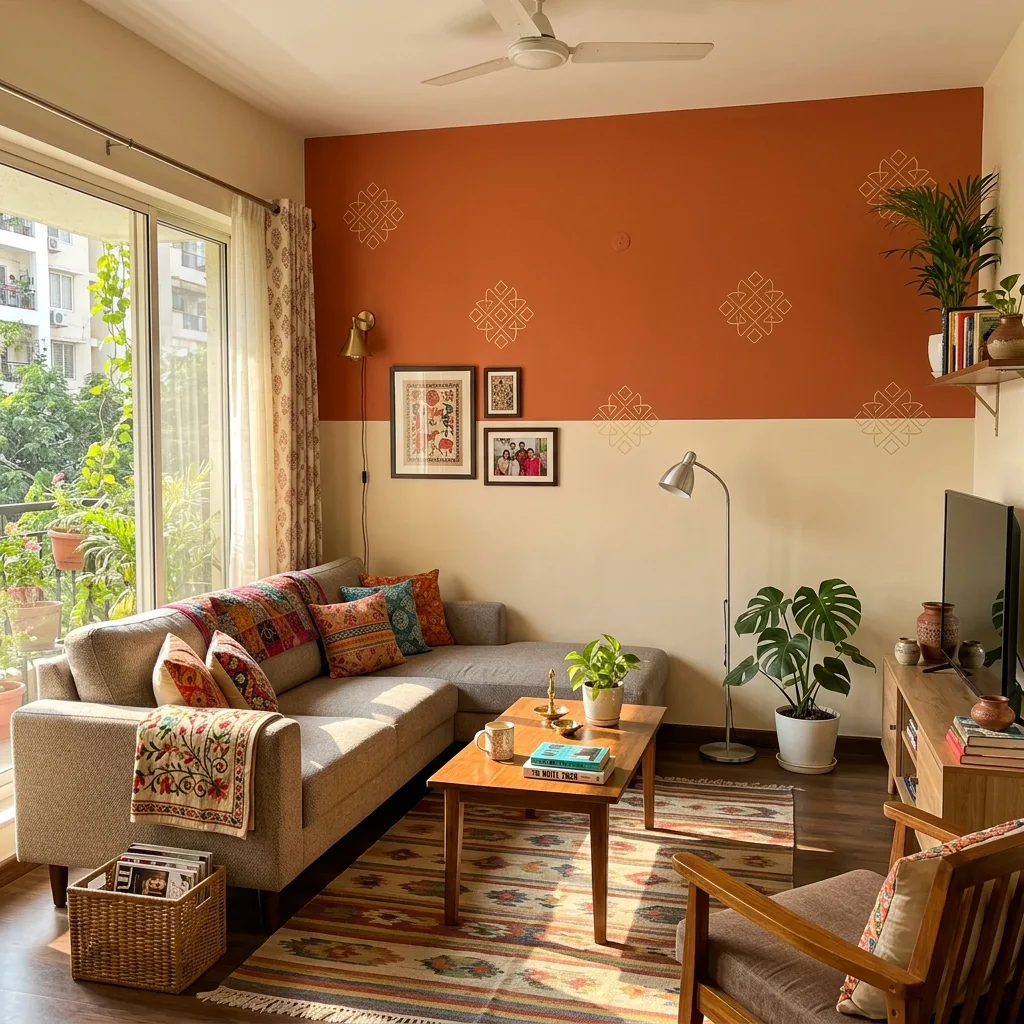
Two-tone colour blocking, painting the upper and lower portions of a wall in two different colours divided by a horizontal line, is the most cost-effective accent wall technique for Indore homes. It uses standard emulsion paint, can be completed in one day, and works in every room type.
This approach delivers incredible architectural interest without requiring any premium textured materials. It relies entirely on smart colour theory and precise execution. Here is a practical breakdown of how to plan and execute a two-tone wall painting in Indore perfectly.
Choosing the dividing line height: The most common ratio seen in design magazines is a one-third lower and two-thirds upper split, or a straight one-half lower and one-half upper division. Neither ratio is universally correct for every room. The one-third lower rule works beautifully in rooms with high ceilings (10 feet and above) because the low horizontal division grounds the room and makes the ceiling feel even taller. In compact Indore apartments with standard 9-foot ceilings, a one-half division (at about 4.5 feet, approximately door handle height) is much more balanced and avoids the awkward “wainscoting that stops too low” visual problem. A practical guide: the division line should sit exactly at or just above the top of the skirting tiles if the room has high skirting, or at chair-rail height (900mm from the floor) if there is no skirting.
Colour combination logic for Indore interiors: Indore’s indoor light is distinctly warm and slightly golden for most of the day due to high exterior UV filtered through standard residential windows. This environmental reality means cool colours, like slate blue, grey-green, and sage, look more muted and balanced in our homes than they appear on Instagram, which is typically photographed in northern European or coastal light. Warm tones, such as terracotta, warm white, dusty rose, and olive green, photograph beautifully and read correctly in Indore’s ambient light. Specific two-tone combinations that consistently work well in Vijay Nagar and Nipania apartments include:
- Terracotta lower / warm white upper: A classic combination that works perfectly with standard marble flooring, adding warmth without creating a dark atmosphere.
- Deep navy lower / off-white upper: A highly dramatic pairing that is best reserved for rooms with at least one large window; you should actively avoid this in small, windowless study rooms.
- Sage green lower / cream upper: A current dominant trend that works seamlessly with both dark wood and light marble tones, remaining neutral enough to not date quickly.
- Charcoal grey lower / light grey upper: The most sophisticated option available, which requires excellent natural lighting and pairs beautifully with white or chrome lighting fixtures.
The masking tape execution technique: A crisp, razor-sharp dividing line between the two colours is the single difference between a professional result and a messy amateur result. The correct technique involves using a premium painter’s masking tape, not regular brown tape which will absolutely bleed. You must apply the tape precisely along the intended division line using a laser or spirit level. Once applied, press the tape edge down firmly with a credit card edge to create a seal and prevent seepage. Paint the upper colour first and allow it to dry completely for a minimum of 4 hours. Next, apply the lower colour. The secret to a perfect line is removing the tape while the lower colour is still slightly wet (not fully dry, as dry tape removal can pull the painted edge up) and peeling it back very slowly at a 45-degree angle. Do not rush this step under any circumstances.
Cost estimate for Indore: A two-tone colour block applied on a standard 12-foot by 9-foot living room wall (one wall, two colours, two coats each) using Asian Paints Royale or an equivalent washable emulsion costs approximately ₹2,500 to ₹4,500 in materials. Professional painter labour for one full day will cost ₹1,200 to ₹2,000. Total estimate: ₹3,700 to ₹6,500 for a wall that dramatically changes the entire room. This is probably the highest value-for-money renovation available to an Indore homeowner. A full room repaint of that exact same room costs between ₹18,000 and ₹28,000. One correctly executed accent wall delivers 70% of the visual transformation for just 20% of the cost.
Technique 2: Stencil Painting
Stencil painting creates repeating geometric or botanical patterns on walls using acrylic paint and a reusable stencil sheet. In Indore, stencil painting costs ₹15 to ₹40 per square foot compared to ₹80 to ₹180 per square foot for imported wallpaper, making it the most cost-effective way to add pattern to an accent wall.
This technique is arguably the most content-rich and design-heavy option available, but it also carries the most variables and the most room for homeowner error. If you are researching budget-friendly accent walls stencils in Indore, you must understand the materials and the strict discipline required for a flawless finish.
Stencil types available in India: There are three primary categories of stencils you can use to transform your space:
- Geometric stencils (patterns like hexagons, diamonds, Moroccan lattice, and herringbone): These are the most forgiving for first-time execution because the geometric regularity makes alignment errors more obvious and therefore correctable early on. They are best suited for modern living rooms and master bedrooms. These are available from local art supply stores in the Saket and Vijay Nagar markets, and are widely available on Flipkart and Amazon.
- Botanical and floral stencils (patterns featuring leaf sprays, trailing branches, and large florals): These designs are much more organic and are slightly more forgiving of minor misalignments because the natural irregularity of botanical forms helps conceal slight registration errors. They are best used for guest bedrooms and quiet reading corners. They are highly popular in Indore’s Zone 2 bungalows where a heritage or traditional aesthetic is often preferred.
- Mandala and Rajasthani-inspired stencils: These are highly relevant for Indore’s specific cultural context. These traditional patterns read as intentional and locally resonant rather than imported, fleeting Instagram trends. They are particularly appropriate for a puja room accent wall, a formal dining area, or a master bedroom feature wall. You can find these at local craft stores and from specialized artisan suppliers in the Sarafa and Rajwada market areas.
Paint selection for stencilling: This specific detail is where most DIY stencil attempts in Indore completely fail. The correct paint for stencilling is a thick, chalk-finish or low-sheen acrylic paint, not the same watery interior emulsion used for rolling the base wall. Standard emulsion is simply too fluid; it bleeds under the plastic stencil edge and produces blurry, messy patterns. A thicker, lower-flow acrylic or chalk paint, applied with a dense foam roller or a dedicated flat stencil brush at very low paint loading, produces incredibly clean, crisp edges. The paint must be barely loaded on the applicator. This technique, known as “dry stippling,” always produces the cleanest possible result.
The registration problem (keeping the pattern aligned): The absolute most common stencil failure is known as “drift”. Drift happens when the pattern gradually shifts horizontally or vertically across the wall as you work, producing a crooked, diagonal repeat that is painfully visible from across the room. To prevent this, you must mark a perfectly level horizontal guide line across the wall using a chalk line before beginning. Furthermore, you must use the stencil’s built-in registration marks (the small crosses or cut-out notches on the border of the plastic sheet) to align each repeat precisely with the previous one. On a standard 12-foot wide wall, even a tiny 2mm drift per repeat compounds into a massive, highly visible misalignment by the 8th repeat. Take two minutes per repeat to check registration with a small spirit level. It is not an optional step.
Cost breakdown for Indore: For a single-colour geometric stencil pattern applied on a standard 10x9 foot accent wall, professionally executed:
- Stencil (reusable, purchased once): ₹400 to ₹1,200 depending on the size and source
- Acrylic stencil paint (one colour, enough for one wall): ₹350 to ₹600
- Painter labour (stencilling takes significantly longer than plain painting, approximately 6 to 8 hours for a 90 sq. ft. wall): ₹2,000 to ₹3,500
- Total estimated cost: ₹2,750 to ₹5,300
Compare this to imported wallpaper applied on that exact same wall: ₹7,200 to ₹16,200 (calculated at ₹80 to ₹180 per sq. ft.) plus an additional ₹3,000 to ₹5,000 for installation. Stencilling delivers approximately 60% to 70% of the visual richness and pattern depth at just 25% to 35% of the cost.
When to hire a professional rather than DIY: Stencilling looks wonderfully simple and satisfying on quick Instagram reels. It is not simple in real life. The registration discipline required over a 90 sq. ft. wall is genuinely skilled, tiring work. I have repainted dozens of homeowner stencil attempts where the drift became so pronounced that the pattern on the last third of the wall was 8 inches lower than the pattern on the first third. If you are doing your first stencil on an accent wall that you actually care about in a high-traffic room, hire a certified applicator for the execution. Do your DIY practice version in a utility room or a garage first.
Technique 3: Geometric Tape Art
Geometric tape art creates angular, multi-colour patterns on walls using painter’s masking tape as a resist. Tape is applied in geometric configurations, the wall is painted, and the tape is removed to reveal crisp angular lines. It requires only standard emulsion paint and painter’s tape, making it the lowest-material-cost accent wall technique available.
Tape art is highly modern, incredibly striking, and requires almost zero special artistic ability, just patience and precision with a roll of tape.
Design configurations that work in Indore homes: Consider these four specific geometric options and their best room applications:
- Triangle split (diagonal bisection): The entire wall is divided diagonally into two massive triangles painted in two contrasting colours. This look is dramatic, bold, and highly modern. It works best in a home study, a teenager’s bedroom, or a compact reading nook where the strong geometry reinforces the contained, cozy nature of the space. It is not ideal in a large drawing room where the massive diagonal line feels arbitrary and overwhelming at scale.
- Chevron or herringbone stripe: This involves multiple angled stripes painted in alternating colours or varying shades of one single colour. It adds immense energy and visual movement to a space. It works wonderfully in long corridors and dedicated home gym areas. However, it requires very precise tape application because every single angle must be consistent or the entire pattern looks wildly uneven.
- Large-scale grid or wainscoting simulation: Vertical and horizontal tape lines are used to create a panel or grid effect that visually simulates raised wooden wall panelling at a microscopic fraction of the cost of actual carpentry. This is very popular in Indore’s Zone 2 bungalows where a colonial or heritage design reference is preferred. It works brilliantly in formal dining rooms and master bedrooms.
- Sunburst or radial pattern: Sharp lines radiating outward from a single central point on the wall. This is highly photogenic and very popular on social media. It is technically very demanding because every single tape line must converge precisely at the exact same origin point without overlapping messily. We recommend professional execution only for radial designs.
The tape sequence for clean geometric patterns: The order of operations matters greatly for a clean result:
- Paint the entire wall completely in the lighter of your two chosen colours (this acts as the base coat). Allow it to cure fully for a minimum of 24 hours.
- Apply premium painter’s masking tape in your chosen geometric configuration, pressing all edges firmly into the wall.
- Paint the darker or accent colour over the designated taped areas.
- Remove the tape carefully while the darker paint is still slightly wet, usually 30 to 60 minutes after application, not after full overnight drying.
- Touch up any minor bleed points with a fine artist’s brush before the paint fully dries.
Common execution failure and tape bleed: Even premium imported painter’s tape will bleed slightly if the wet paint is applied too thickly with a loaded roller, or if the tape edges are not pressed down firmly enough against the wall surface. Prevention is simple: after applying your tape design, run a fingertip firmly along the entire length of every single tape edge to seal it. Crucially, on textured walls (any surface that is not perfectly smooth putty), tape art is not recommended at all. The rough texture creates microscopic gaps under the tape edge where watery paint bleeds freely, ruining the crisp lines.
Cost estimate: Geometric tape art applied on a 12x9 foot wall using two colours of standard washable emulsion, with professional execution: ₹3,000 to ₹5,500. The actual material cost is negligible (standard emulsion and premium painter’s tape cost around ₹200 to ₹400). The labour cost is slightly higher than plain painting because of the intense precision and setup time involved in laying the tape correctly.
Technique 4: Texture Accent Walls on a Budget
Textured accent walls using Asian Paints Royale Play or Sirca metallic plaster can be executed on a single wall for ₹35 to ₹80 per square foot, significantly less than applying texture throughout a full room. A single bedroom or living room texture accent wall costs ₹4,000 to ₹9,500 complete.
Texture adds a tactile, physical dimension to a room that flat paint and stencils simply cannot match. Here are the four most relevant texture options for the Indore market, along with honest performance and cost information:
Royale Play Sand Finish (Asian Paints): This creates a granular, sand-like texture applied with a specialized sponge roller or a heavily textured roller. It produces a warm, tactile surface that reads completely differently in different lighting conditions. It looks flat and subtle in diffused daytime light, but rich and highly dimensional under angled evening spotlighting. The best colours for this finish are warm neutrals like ecru, sand, and warm grey. It is easily executed by a trained painter. Cost: ₹35 to ₹55 per sq. ft. including labour. It is highly durable, washable, and easily re-paintable.
Venetian Plaster Effect (Sirca or Asian Paints Royale Play Metallics): This produces a smooth, burnished finish with beautiful subtle colour variations and a low sophisticated sheen. It closely creates the appearance of polished stone or aged European plaster. It is far more labour-intensive than a sand finish because it requires multiple ultra-thin applications and a final vigorous burnishing step with a steel trowel. It is best used in luxury master bedrooms and formal drawing rooms. It is not recommended for kitchens or areas with high moisture exposure. Cost: ₹55 to ₹80 per sq. ft. including labour. This strictly requires a certified texture applicator for quality execution.
Lace or Sponge Texture (The ultra-budget option): This involves using a natural sea sponge or even a crumpled plastic bag to dab a second colour of emulsion gently over a dry base coat, creating an organic, mottled texture. This is the absolute simplest texture technique available as no special expensive tools are required. It is best suited for guest bedrooms and puja rooms where a warm, handcrafted, artisanal quality is desirable. Cost: ₹15 to ₹25 per sq. ft. including labour (this is primarily a labour cost, with very minimal additional paint material needed). This can easily be DIY executed with a little practice on a small test piece of cardboard first.
Brick-effect stencil texture: A thick stencil cut with a raised brick pattern is used with a slightly thicker paint or wall putty mixture to create a physical relief that beautifully mimics exposed brickwork. This is highly popular in Indore’s trendy café-aesthetic home bars and cozy study areas. Cost: ₹30 to ₹50 per sq. ft. Be aware that durability is lower than painted textures if the relief is very thin. A thicker putty application is much more durable against bumps, but is slightly more expensive in material cost.
Colour Combinations That Work in Indore’s Indoor Light
Interior wall colours in Indore read significantly warmer and more saturated than they appear in paint chips or north-facing European photography. Warm tones like terracotta, warm white, olive, and dusty rose perform reliably in Indore’s indoor light.
This is the most critical design factor that generic online blogs ignore. The specific quality of light and the specific flooring materials common in our city dictate which colours will actually look good on your walls. Here is a curated guide to colour combinations that work beautifully in our local environment:
For marble-floored living rooms (most Vijay Nagar and Nipania apartments): Standard white Indian marble flooring has warm undertones (beige and grey veins) rather than a pure, sterile cool white. This means that cool-toned accent walls, like pure slate greys and icy steel blues, often create an uncomfortable visual clash at floor level. Warm-toned walls complement natural marble effortlessly. Best combinations:
- Warm terracotta accent + cream on other walls + white marble floor: A classic, cohesive, and timeless look in Indore’s residential context.
- Deep dusty rose + soft blush pink on other walls + marble: Highly current, slightly feminine, and works beautifully in modern master bedrooms.
- Warm olive green + soft white on other walls + marble: Very contemporary and calming, working excellently to ground compact living rooms.
For granite-floored older Palasia and Saket bungalows: Older heritage bungalows often feature black, dark green, or red granite floors, providing very high contrast flooring. These rooms can easily accept much bolder, darker wall colours because the heavy floor already provides very strong visual anchoring. Best combinations:
- Deep bottle green accent + off-white on other walls + dark granite: Very colonial, formal, and works perfectly in grand dining rooms.
- Warm mustard yellow + cream on other walls + dark floor: A beautiful traditional Indian aesthetic that feels highly festive and welcoming.
- Navy blue accent + warm white on other walls + dark floor: Extremely sophisticated, working best in home libraries or studies.
For apartments and flats with vitrified tile flooring (most Zone 3 mid-income homes): Standard vitrified tile is typically a light beige or cream colour. The floor generally reads as completely neutral, giving you much more flexibility with wall colours. Best budget combinations using standard emulsion paint (no premium required):
- Two-tone terracotta lower + cream upper: ₹3,500 to ₹5,000 total including labour.
- Sage green accent + crisp white on remaining walls: ₹2,500 to ₹4,500 total.
- Warm grey accent + light grey on other walls: ₹2,800 to ₹4,800 total.
Colours to aggressively avoid as accent walls in Indore’s typical indoor light:
- Pure cool grey without any yellow undertone: This almost always looks lavender or purple in Indore’s warm afternoon light.
- Bright lime green or neon tones: These always look cheap in natural light; they truly only work well under specific gallery-type artificial lighting.
- Very dark navy or pitch black on ceilings or as a single wall without skylights or large windows: This actively absorbs the limited natural light in compact apartments and makes rooms feel claustrophobic like caves.
Comparison Table: Four Accent Wall Techniques by Budget, Skill, and Impact
The table below breaks down the true cost and feasibility of the most popular accent wall techniques available to homeowners in Indore, comparing them directly against the benchmark of imported wallpaper.
| Technique | Material Cost (12×9 ft wall) | Professional Labour | Total Estimated Cost | DIY Feasibility | Impact Level | Reversibility |
|---|---|---|---|---|---|---|
| Two-Tone Colour Block | ₹1,200–₹2,500 | ₹1,200–₹2,000 | ₹2,400–₹4,500 | High — doable carefully | High | Fully repaintable |
| Stencil Pattern | ₹750–₹1,800 | ₹2,000–₹3,500 | ₹2,750–₹5,300 | Medium — registration skill required | Very high | Repaintable with primer coat |
| Geometric Tape Art | ₹800–₹2,000 | ₹2,500–₹4,000 | ₹3,300–₹6,000 | Medium — tape precision required | High–Very high | Fully repaintable |
| Sand/Sponge Texture | ₹900–₹2,500 | ₹2,500–₹5,000 | ₹3,400–₹7,500 | Low — requires trained technique | Very high | Repaintable (texture visible under paint) |
| Venetian Plaster | ₹2,000–₹4,500 | ₹4,000–₹7,500 | ₹6,000–₹12,000 | Not recommended DIY | Exceptional | Not reversible without full replastering |
| Imported Wallpaper | ₹7,200–₹16,200 | ₹3,000–₹5,000 | ₹10,200–₹21,200 | Not recommended DIY | Exceptional | Removable but wall damage likely |
Verdict: For maximum visual impact at minimum cost in Indore homes, a professionally executed two-tone colour block or geometric stencil on a single accent wall consistently delivers the best value-per-rupee. Both techniques use standard emulsion paint, are fully repaintable for future changes, and can be completed in one to two days. Texture finishes (Venetian plaster, Royale Play) produce a superior result but at two to three times the cost. Imported wallpaper is the premium option with the highest installation risk and the least flexibility. Vishwas Homes executes all four techniques in Indore with a written warranty.
Before You Start: The Surface Preparation Your Accent Wall Needs
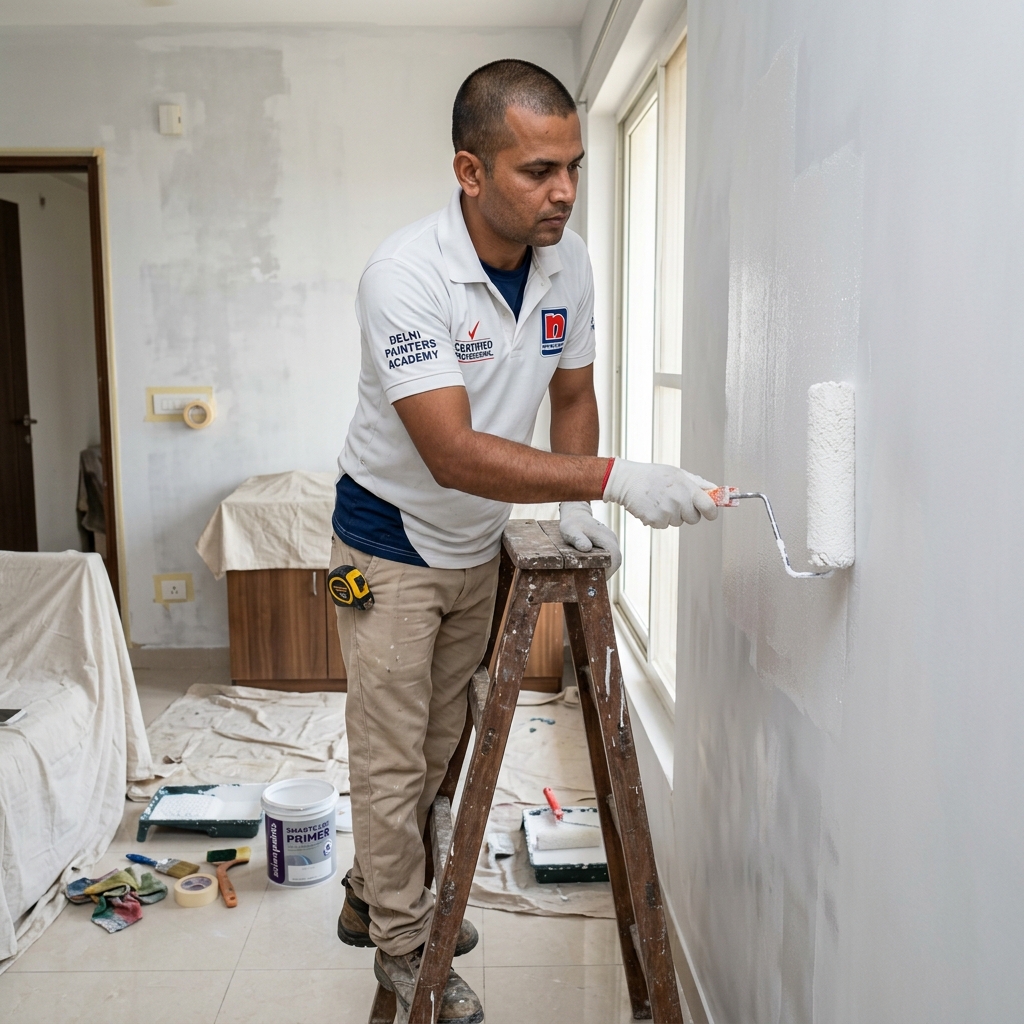
An accent wall receives more visual attention than any other wall in a room, which means any surface imperfection, crack, or texture inconsistency is far more visible than on a plain wall. Surface preparation for an accent wall must be to a higher standard than the rest of the room, not the same standard.
A two-tone colour block featuring a slightly wavy dividing line due to a bumpy wall, or a beautiful stencil pattern applied to a wall with highly visible old repair patches beneath it, is far more visually damaging than a plain painted wall with those exact same imperfections. The pattern actively draws the eye, and the eye immediately finds every single flaw.
I always tell clients: your accent wall should have the smoothest, absolute best-prepared surface in the entire room. Budget the extra half day of preparation. It usually costs only ₹500 to ₹1,000 in additional putty and sanding labour, and it is the absolute difference between a wall you proudly show guests and a wall you constantly make excuses for.
Three preparation checks specific to accent walls:
- Check for and carefully repair all hairline cracks before applying any technique using a flexible filler, not hard putty. For a detailed guide on this, read our comprehensive surface preparation guide on crack treatment before painting.
- Sand the entire wall surface to a completely smooth, even finish before marking lines or stencilling. Small bumps and ridges cause stencil edges to lift and tape to bleed heavily.
- Apply a fresh base coat of your intended background colour with an alkali-resistant primer underneath, and allow it to cure fully (a minimum of 48 hours) before any stencil, tape, or two-tone technique begins.
Frequently Asked Questions
What is the cheapest way to create an accent wall in an Indore flat?
The cheapest method is a two-tone colour block using standard emulsion paint. The total cost ranges from ₹2,400 to ₹4,500 for a standard 12×9 ft wall including professional labour. It can be completed in one day without requiring any special materials.
Where can I buy wall stencils in Indore?
Local options include art supply stores in the Vijay Nagar market and MG Road area, as well as craft supply stores in Saket and the Pipliyahana market. Online, you can check Amazon and Flipkart (search “wall stencil India” and filter for sizes above 12 inches for wall-scale application). Custom laser-cut acrylic stencils are also available from local fabricators near Rajwada.
Can a stencil accent wall be painted over if I want to change it later?
Yes. You simply apply one coat of alkali-resistant primer over the stencilled surface before applying the new colour. Without the primer coat, the dark stencil colour may bleed through the new topcoat, especially if you used deep colours like terracotta or navy blue.
What is the best accent wall colour for a small Indore apartment living room?
For compact rooms, avoid very dark colours on the primary accent wall, which reduce the perceived depth rather than increasing it. Warm medium tones, like dusty rose, terracotta, and sage green, read best in Indore’s warm indoor light and create depth without darkness. Always test a 30×30 cm sample patch before committing.
How long does a stencil accent wall take to complete?
With professional execution, it takes about 6 to 10 hours for a 90 sq. ft. wall. This includes preparation, registration setup, stencilling, and final touch-ups. The wall must not be touched or disturbed for 24 hours after completion for the pattern to fully cure. It is not a quick same-day project.
Is geometric tape art DIY-friendly for a first-timer in Indore?
For a simple diagonal two-colour split, yes, provided you use premium painter’s tape, a spirit level, and have patience. For a complex chevron or sunburst pattern, absolutely no. The intense precision required to maintain consistent angles over 12 feet of wall requires significant experience. For a first DIY attempt, start with the simplest possible configuration and practice the wet tape removal technique on a small test section first.
Conclusion: Planning Your Festive Season Accent Wall in Indore
Navratri and Diwali are eight to ten weeks away. If you have been scrolling through endless accent wall ideas on Pinterest and Instagram and have not yet decided what you actually want, this is the week to decide. Booking a professional painter in October for festive execution means you are already behind the curve in most Vijay Nagar and Palasia localities, where the best painters are booked solid six to eight weeks out.
Here is how I would simplify the choice for your home. Ask yourself three simple questions: Is your room compact (under 300 sq. ft. living area)? Choose a two-tone colour block; it adds massive depth without introducing a pattern that overwhelms small spaces. Is your room large with a very clear, unbroken focal wall? Choose a stencil or a texture finish; the large scale benefits from the visual complexity. Do you want to do this yourself for the very first time? Choose two-tone tape art. Do you want an exceptional finish that you will proudly live with for the next eight years? Choose Venetian plaster or a Royale Play texture, and ensure you hire a certified applicator.
If you are located in Indore and want to discuss which specific technique suits your unique room, considering dimensions, light direction, existing flooring, and furniture scale, WhatsApp us at 070672 58993 or visit our showroom in Pipliyahana. We will assess the room, show you finished reference samples from previous local Indore projects, and provide a quote specifically for your wall. There is no obligation. We have been helping Indore homes look exactly how their owners imagined since 1980.

About the Author: Rajesh Vishwas
Rajesh Vishwas has been a leading figure in Indore’s painting and waterproofing trade since 1980. With 45+ years of hands-on experience in Indore, Rajesh specializes in delivering highly durable interior finishes, elegant Textures and Designer Walls, and creative accent wall solutions for homes across the city.